Established Since 1976
HDB & BCA Licensed Contractor
HDB Licensed No. HB-02-0677-D
For enquires, please call or whatapps us
Tel:67479019 or 96319288


Aluminium Sliding & Casement Windows Singapore
✓ Since 1976 ✓ HDB Licensed HB-02-0677-D ✓ Free HDB Permit Application ✓ Local Factory ✓ 2 Weeks Installation

Ho Ho supplies and installs aluminium sliding and casement windows for HDB flats, condos and landed homes across Singapore.
Since 1976, we have fabricated our windows in our own Singapore factory. As an HDB-licensed and BCA-registered contractor, we offer a wide range of aluminium profiles, frame colours and glass options.
Sliding windows are more affordable, easy to use and low-maintenance. Casement windows give better ventilation, a tighter seal and better sound insulation. The right choice depends on where the window is installed, its size, your ventilation and noise needs, and your budget.
Not sure which window suits your home? WhatsApp us a photo of your window for free advice, or visit our Pandan Loop showroom to see our window profiles, frame colours and glass options in person.

Ho Ho Engineering is listed in HDB's Directory of Renovation Contractors (Reg. No. HB-02-0677-D), registered since 1976 with no demerit points. Verify on HDB's website →
See how we fabricate our aluminium windows and doors at our own factory in Singapore.

Sliding vs Casement Windows: Which Is Better for Your Home?

Both sliding and casement windows are popular in Singapore homes, but they suit different spaces.
Sliding windows are generally more affordable, easy to operate and require less maintenance, making them a popular choice for HDB corridor-facing windows and service yards.
Casement windows open wider and provide tighter sealing, offering better ventilation, sound insulation and wind resistance.

Choose sliding windows if you:
-
Live in an HDB corridor-facing or ground-floor unit
-
Want the most affordable glass window option
-
Prefer a durable option with minimal maintenance
-
Want windows that are easy to open and close from inside
Choose casement windows if you:
-
Want maximum airflow and natural light
-
Need better noise reduction for a bedroom or a unit facing a busy road
-
Live on a high floor with strong winds
-
Want a tighter seal against insects

Still unsure? Many homes combine both, for example sliding windows along the corridor and casement windows in the bedrooms and kitchen. WhatsApp us a photo of your windows and we'll recommend the best option for each room.
For a more detailed comparison, read our guide: Casement vs Sliding Windows: Which Is Better for Singapore Homes?

Aluminium Sliding And Casement Window Price in Singapore
Sliding Window Pricing


Casement Window Pricing


Prices shown are per square foot and include supply and installation, unless stated otherwise. Orders below 100 sq ft are subject to an additional $100 lump-sum charge.
Top-hung panels are available as an add-on at $150 per panel. Our Vertical Sliding Window starts from $600 per set for sizes up to 2 ft (W) × 4 ft (H), with no minimum order requirement.
For HDB flats, HDB window permit application is included at no additional cost.
What Affects the Price of Your Windows?
-
Window type: Sliding windows are generally more affordable than casement windows.
-
Size and number of panels: Larger window openings and more panels require more aluminium, glass and hardware.
-
Additional features: Top-hung panels, 2-section designs and built-in mesh will increase the overall price.
-
Aluminium profile: Euro profile windows use heavier-duty aluminium frames and can include features such as multipoint locking for added strength and security.
-
Glass type: Clear glass is generally the most affordable. Tinted, frosted, laminated and double-glazed glass will cost more.
-
Site conditions: Difficult-to-access windows, such as those at some HDB maisonette balconies, may require additional equipment or scaffolding.
For a more accurate quotation, WhatsApp us a photo of your existing windows together with the approximate width and height.

Types of Aluminium Sliding Windows
We offer a range of aluminium sliding windows for HDB flats, condos and landed homes, from budget-friendly standard windows to heavy-duty Euro profile systems. Choose based on your ventilation, privacy and budget needs.
Video showing the difference between prime and standard sliding window
HDB Sliding Window
Our most affordable option: simple, reliable and easy to maintain. Ideal for HDB corridor units, service yards and bedrooms. Available in 2 to 6 panels, with 3-track systems allowing up to two-thirds of the window to open.
Prime Sliding Window
An upgraded sliding window with heavier aluminium profile, smoother rollers and better sealing. A good balance between price and performance for homeowners who want more durability than a standard window.
Euro Profile Sliding Window
Our premium sliding window, with heavy-duty aluminium frames for better strength, sealing and sound insulation. Recommended for high floors, windy locations and homes with tall window.
Click here to find out more about the difference between the three profile of sliding window!

Sliding Window with Top Hung
A sliding window with a top hung panel above it. The top hung panel lets in fresh air even when it rains or when the main window is closed, making it suited for room along common corridor, kitchens and non-air-conditioned rooms.
Click here to find more about the advantages, disadvantages & HDB Requirements regarding top hung sliding window!

Double Section Sliding Window
Two independent sliding sections, one above the other. Open the top section for airflow while keeping the bottom closed for privacy. A popular choice for HDB corridor-facing units, often with frosted glass below and clear glass above.

Vertical Sliding Window (Slide Up and Down)
One fixed panel and one panel that slides up or down. It offers good privacy and can come with a built-in mesh. Ideal for common corridor, service yard and internal window in kitchen.
Advantages and Disadvantages of Sliding Window

Sliding windows are a popular choice for Singapore homes because they are affordable, durable, easy to operate and relatively low maintenance. Their wider glass panels can also provide a more unobstructed view with fewer aluminium frames.
However, sliding windows have some limitations. The panels overlap when opened, resulting in a smaller ventilation opening compared with casement windows, while HDB corridor-facing windows may require additional consideration for privacy. The sliding tracks also need occasional cleaning to maintain smooth operation.
Want to know whether sliding windows are right for your home? Read our full guide on the Advantages and Disadvantages of Sliding Windows in Singapore.
Two Section Sliding Windows

Advantages of 2-Section Sliding Windows
Two-section sliding windows are a great choice for HDB corridor units, offering an effective balance between privacy and ventilation. This design allows homeowners to keep the top section open for airflow while keeping the bottom section closed, reducing visibility from outside. It’s an ideal solution for maintaining comfort without sacrificing privacy.
Disadvantages of 2-Section Sliding Windows
Compared to standard single-section sliding windows, two-section models are generally more expensive. The higher cost is due to additional materials and the more complex installation process, which may require extra labor. However, many homeowners find the added functionality worth the investment.
Design Considerations for 2-Section Sliding Windows
When planning a 2-section sliding window, it's essential that the top and bottom sections are either equal in size or that the top section is smaller. This ensures the bottom panel can adequately support the overall structure, maintaining the window’s strength and durability over time.
Customization Options for 2-Section Sliding Windows
HDB homeowners can personalise their 2-section sliding windows by choosing different types of glass for each section. A common configuration includes privacy glass (e.g., frosted or tinted) for the bottom panel to block views from the corridor, paired with clear or lightly tinted glass—such as light blue—for the top panel to maximise natural light while maintaining a sense of privacy.
Conclusion
For homeowners prioritising privacy and comfort, 2-section sliding windows are an excellent choice for HDB corridor-facing units. Though they come at a higher cost than standard models, their enhanced functionality and customisation options make them a worthwhile investment.


Sliding Windows With Adjustable Lourve
Advantages of Sliding Windows with Adjustable Louvres
Sliding windows with adjustable louvres are a premium solution for HDB corridor units, offering excellent ventilation and privacy control. Homeowners can keep the bottom sliding panel closed for privacy while adjusting the top louvre to allow airflow. This setup is ideal for maintaining comfort and seclusion without needing to open the entire window.
Disadvantages of Sliding Windows with Adjustable Louvres
This configuration is typically the most expensive sliding window option due to the added materials and labor involved in integrating the louvre mechanism. Additionally, sliding windows with adjustable louvres provide significantly less sound insulation compared to 2-section sliding windows, making them less ideal for noise-sensitive environments.


Where Can Sliding Windows Be Installed?
Sliding windows are a practical and space-saving option that can be installed in various parts of the home, including:
-
Bedroom
-
Living Room
-
Kitchen
-
Balcony
-
Courtyard
-
HDB BTO Service Yard


Key Guidelines for Installing Sliding Windows in HDB Flats


Sliding windows are a popular and versatile option for HDB flats, available in configurations ranging from 2 to 6 panels—6 panels being the maximum per window set.
-
Ventilation Tip:
For maximum airflow, choose sliding windows with 3 tracks. Both 3-panel and 6-panel sliding windows with 3-track systems allow two-thirds of the window to be opened, offering excellent ventilation for corridor-facing or indoor spaces.
-
HDB Regulations:
According to HDB guidelines, the width of each sliding window must fall between 500 mm and 1200 mm. However, for better durability and smoother operation, it is recommended to keep each sliding panel under 1000 mm in width. This helps reduce stress on the rollers and prolongs the life of your window system.
-
Permit Application Included:
We take care of all necessary HDB permit applications for your sliding window installation at no extra cost, ensuring a hassle-free process.
Why Choose Casement Windows for Your Singapore Home?

1) Excellent Ventilation and Natural Light
Casement windows open wide on side hinges, allowing maximum airflow into your home—perfect for Singapore’s humid climate. They also let in more natural light compared to sliding windows, which are partially blocked by overlapping panels.
2) Sealed Design for Insect Control, Better Sound Insulation, and Wind Resistance
Unlike sliding windows, casement windows close tightly with no visible gaps. This helps prevent insects from entering, improves sound insulation, and eliminates rattling during strong winds—making them ideal for high-floor or windy locations.
3) Enhanced Durability with Secure Locking Systems
Our casement windows are crafted from high-quality aluminium and fitted with stainless steel hinges or friction stays, along with durable handles for long-term reliability. For added strength and security, homeowners can opt for our Euro profile casement windows, which feature thicker frames and a multipoint locking system for superior protection and performance.
Where to Install Casement Windows in Your Home
1) Living Room: Maximise Light and View
Casement windows are ideal for living rooms, offering wide openings that allow abundant natural light and airflow. Their full-panel design enhances your view, making them perfect for units facing greenery or open spaces.
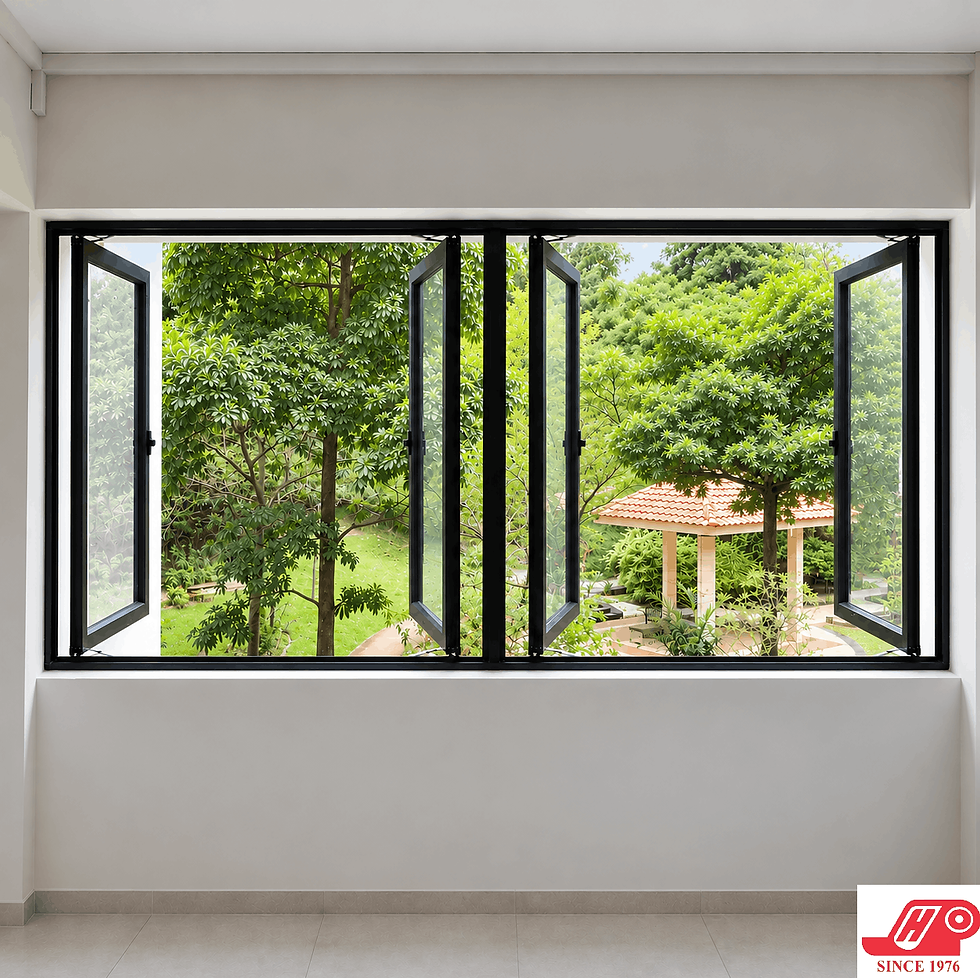
If you prefer an even more open view, consider our premium slide and swing windows or folding windows for a seamless, panoramic experience.


2) Kitchen: Ventilate Heat and Odours Efficiently
Casement windows in the kitchen provide maximum ventilation, helping to expel cooking heat, steam, and odours effectively. Their outward-opening design keeps your workspace clear and easy to clean, while the tight seal prevents insects from entering the area.


3) Bedroom: Enjoy Peace, Privacy, and Comfort
Casement windows offer excellent insulation against outdoor noise, making them a great choice for bedrooms. They close tightly for better sound control compared to sliding windows. You can choose frosted or tinted glass for privacy and add window grilles for added safety.
For even better noise reduction, opt for our soundproof window upgrade for a quieter, more restful space.


Some casement window configurations include a top hung window panel above the main window. This feature allows for continuous ventilation—even during rainy weather or when you're away from home. It's particularly useful for kitchens or non-air-conditioned bedrooms that require steady airflow.
However, keep in mind that adding a top hung panel will reduce the height of your main casement window, which can make the window feel shorter and limit the overall view.
If you don’t plan to use this feature often, it’s generally best to leave it out.
Note: Installing a top hung window will incur additional cost.
Special Casement Windows


Casement windows can be uniquely customised to suit different architectural styles and functional needs. Below are some special variations:
1. Lattice Casement Window
Featured in the first image, this window incorporates decorative lattice bars that add a classical or colonial charm. It's a popular choice for homeowners looking to infuse a country or vintage European touch into their interiors.
2. Casement Window with Bottom Fixed Panel (Bay Window)
The second image shows a casement window with a fixed glass panel at the bottom—commonly used for bay window setups. This design allows you to enjoy extended views while keeping the lower section static for safety and structure.
3. Picture Casement Window
The third window setup combines a large fixed centre panel (picture window) with side casement panels that can open. This design maximises natural light and views while still allowing for airflow through the smaller casement openings.
4. Semi-Circle Casement Window
The last image features a semi-circular (arched) casement window, adding a soft architectural focal point. Often used in bathrooms or stairwells, it balances privacy and design elegance—especially when paired with frosted glass.
Casement Window For Private Properties (Condo & Landed)


When the wall height below your window is less than one meter, it is recommended to install a fixed panel beneath the casement window for enhanced safety, particularly if you do not plan to use window grilles. For optimal safety, this fixed panel should be made of either laminated or tempered glass.
It's important to note that fixed panels are generally not approved for HDB properties. For specific guidelines, please consult your respective HDB branch office.
For homeowners who enjoy a picturesque view and wish to preserve it, incorporating a fixed panel in the middle of your window setup is an option.
However, this arrangement may limit ventilation as only the side portions of the window can be opened. If maintaining both view and full window functionality is a priority, consider our versatile slide and swing windows.
Additionally, choosing a combination of casement windows with a fixed panel can be a cost-effective alternative to slide and swing windows, offering both affordability and functionality without compromising on style or safety.

Key Guidelines for Installing Casement Windows in HDB Flats

When installing casement windows in HDB flats, it’s essential to comply with regulatory guidelines to ensure safety, durability, and long-term performance. Below are the three key criteria to keep in mind:
Location Restrictions
Casement windows are not allowed along common corridors or in ground-level units. This regulation prevents obstruction of public pathways and minimises the risk of injury from outward-opening panels.
Size Specifications
HDB requires casement windows to be between 500 mm and 700 mm in width. This size limitation:
-
Prevents excessive weight that can shorten the window's lifespan
-
Reduces the risk of falls, especially for homes without window grilles, as wider windows require more outward reach to close safely
Note: Many older units have casement windows exceeding this width, which leads to increased wear on the hardware and reduced durability.
Hardware Requirements
At Ho Ho, we use Grade 304 stainless steel for the friction stays in all our casement windows. Our friction stays are 2.50 mm thick and extend to at least half the width of the window panel. These specifications ensure:
-
Smooth operation with regular use
-
Strong resistance to corrosion in Singapore’s humid climate
-
Long-lasting durability and enhanced safety
Some suppliers may cut costs by using Grade 430 stainless steel, which is less resistant to corrosion and significantly shortens the window’s lifespan.
Windows For HDB Maisonette Balcony

For HDB Maisonette balconies, the windows are notably tall, providing homeowners with the option to either install a window below and a blind above or opt for a window spanning the entire height.
Opting for a full-height window installation requires scaffolding, which can contribute to higher costs for installing HDB Maisonette Balcony Windows. Additionally, installing windows at this height necessitates skilled workers comfortable with heights, leading to higher compensation.
Frame & Glass Options For Sliding And Casement Windows
Aluminium Frame Colour


Explore Other Popular Glass Window Types in Singapore


Ready To Purchase Your Sliding and Casement Window
Contact Ho Ho Today!
Showroom Address
194 Pandan Loop #07-07
Singapore 128383 Pantech Business Hub
Mon to Fri 10 to 4.30 pm
Sat 10 to 2pm
Sun & PH Closed
Contact Us
Frequently Asked Questions For Sliding & Casement Windows
Casement & Sliding Window Insights by Experts for Singapore Homeowners
Stay informed with expert guides and window care tips to help you choose, maintain, and upgrade your home’s windows with confidence.
1. What Is a Casement Window? Everything You Need to Know Before Installing One in Singapore
2. Casement vs Sliding Windows: Which Is Better for Singapore Homes?
3. How to Choose the Right Casement Window for Your Home?
4. HDB Casement Window Regulations in Singapore: What Every Homeowner Should Know
5. HDB BTO Service Yard Window in Singapore (2025 Complete Guide by Industry Experts)
6.Advantages and Disadvantages of Sliding Windows in Singapore
Last updated 6 Oct 2026